
3min read
OpenGL Procedural Terrain
This project implements a GPU-accelerated Marching Cubes pipeline in OpenGL, based on an NVIDIA paper for real-time procedural terrain. The goal was to extract isosurfaces from a procedurally generated density field and render them interactively, with chunked LOD for scalability and clear visual debugging to aid development.
How it works
A 3D density field is generated procedurally and evaluated entirely on the GPU. The volume is partitioned into chunks; each chunk runs a two-pass Marching Cubes pipeline:
Pass 1 — Classify & Count: For every cell, the algorithm samples the density at the eight corners, computes the cube index, and looks up the triangle count using the edge/tri tables.
Prefix Sum & Compaction: A parallel scan compacts “active” cells and computes write offsets for triangle emission.
Pass 2 — Triangle Generation: Active cells interpolate edge vertices and write final triangles into a GPU buffer for rendering.
Normals are computed for smooth shading (e.g., from the density gradient). The final mesh for each chunk is drawn via OpenGL.
Architecture
The system is organized as a set of OpenGL compute shaders and draw stages over chunked volumes:
Chunked LOD: The world is divided into fixed-size chunks. Chunks update independently and can be culled, refreshed, or refined without blocking the entire volume.
GPU-First Data Flow: Density evaluation, cell classification, prefix sums, and triangle generation all occur on the GPU using SSBOs/UBOs and lookup textures for the Marching Cubes tables.
Render Path: Generated vertices/indices are kept on the GPU and rendered directly with standard OpenGL draw calls.
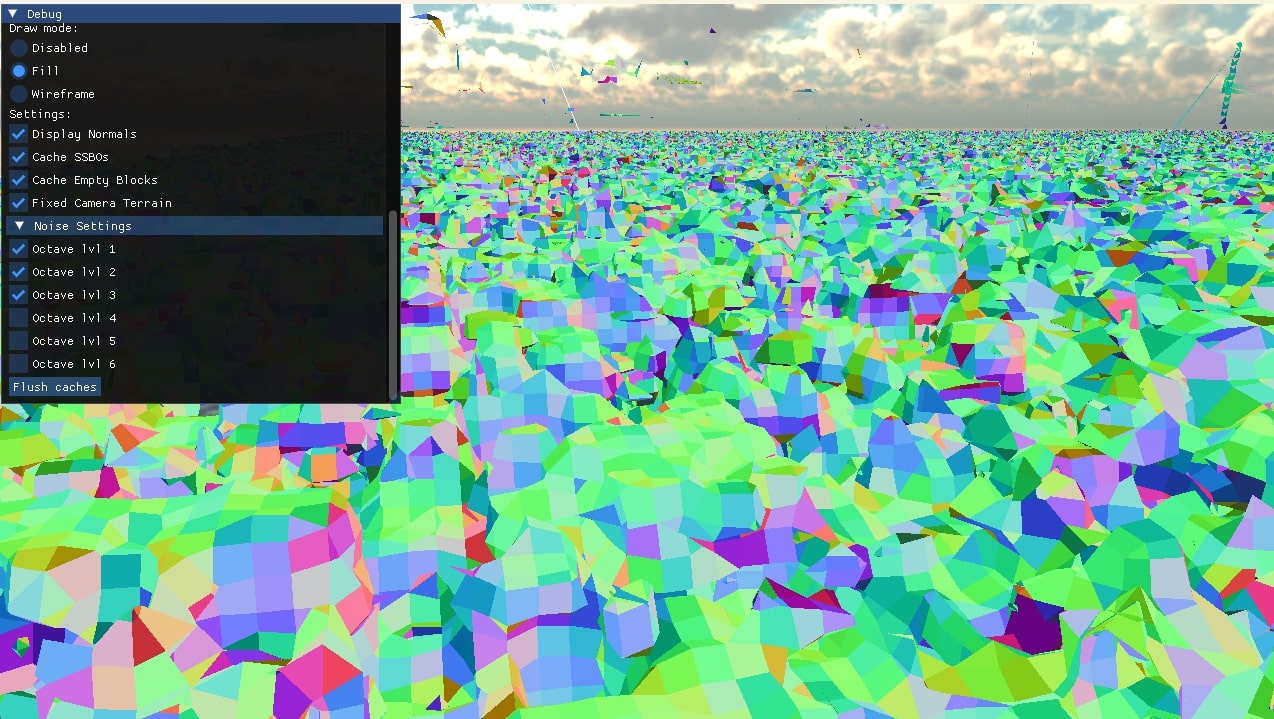
Debug Views: Optional overlays visualize chunk bounds, active-cell density, and triangle counts to diagnose LOD and surface quality in real time.
Results & Takeaways
The pipeline produces a prototype to render high-quality isosurfaces at interactive frame rates, scaling with chunks, culling, and LODs to allow for large rendered terrains at real-time. The current implementation has various bugs related to culling and rendering, but the core system functions as expected, and can generate 3d noise terrain, allowing for features such as overhangs and caves that basic heightmap approaches cannot perform. A proper visual debugging system shortened iteration time and made it easy to tune thresholds and parameters for the best final result.
Real-Time Surface Extraction: Fully GPU-resident Marching Cubes with two-pass generation and compaction.
Scalable LOD: Chunk-based updates and culling keep performance predictable as scene size grows.
Production-Friendly Workflow: Clear debug overlays and a tidy data flow made diagnosing topology issues and normal artifacts straightforward.
Overall, this project strengthened my understanding of GPU compute pipelines, prefix-sum based compaction, chunked LOD design, and the practical details of shading and normal computation for procedurally generated surfaces.
See More
The code can be found in this Github Repository